WHAT ISLAM SAYS ABOUT...
Hajj and Umrah
Questions related to Hajj and Umrah
Reviewed by the Yaqeen Institute research team · Updated
What is Hajj?
Hajj is a sacred pilgrimage, performed annually by Muslims, to Masjid al-Haram (the Sacred Mosque erected by Prophet Abraham) in Mecca. It is the 5th pillar of Islam and is expected to be completed once in a Muslim’s lifetime.
Why is Hajj important?
The importance of Hajj is not limited to it being an opportunity to seek forgiveness for past sins but it allows believers to connect to Prophet Abraham (pbuh) and Prophet Muhammad (pbuh) through the rituals of Hajj. The Hajj pilgrimage also brings together the global Muslim community from all corners of the world, synchronized in a profound ritual before the One God as a single family despite their differences in race, ethnicity, and ages.
Where does Hajj take place?
Hajj takes place in and around the holy city of Mecca, located in present day Saudi Arabia. Some of the Hajj rites take place at the Ka’bah (the epicenter of Ancient Mosque built by Prophet Abraham), others at the nearby hills of Safa and Marwa (where Hagar sought drinking water for her child), and others outside the mosque at Mina, Muzdalifa, and Mount Arafah.
When is Hajj?
Hajj occurs during the first 13 days of the month of Dhul-Hijjah, the 12th or last month of the Islamic (lunar) Calendar with the rituals starting primarily on the 8th day of Dhul-Hijjah. Some scholars hold that the first 10 days of Dhul Hijjah are last the final 10 days of Prophet Moses’ 40 night repose with God at Mount Sinai, wherein Allah communicated with him directly and gave him the 10 commandments.
In 2023, Hajj will begin on June 26th and the day of Arafat will take place on June 28th. These dates are tentative until the new moon is sighted at the beginning of the month.
Video: Episode 1: The Sacred Months
How long does Hajj last?
Hajj typically lasts 5-6 days, starting on the 8th or 9th day of Dhul-Hijjah, the last month of the Islamic (lunar) Calendar, and ending on the 12th or 13th day of Dhul-Hijjah.
Who is required to perform Hajj?
Hajj is required by all physically and financially able Muslims. It is required to be performed once in a Muslim’s lifetime.
How is Hajj performed?
Hajj is comprised of 6 main rituals – Ihram, Arafat, Jamarat, Udhiya, Sa’i, and Tawaf – and the following steps:
1) Go into a state of Ihram (the sacramental state of a Hajj-goer) and make your intention to perform Hajj.
2) Proceed to the city of Mina, where the day is spent in prayer and the remembrance of God.
3) From Mina, head to the city of Arafat, where the day is spent in prayer. Many Muslims who are not performing Hajj choose to fast on this day.
4) After sunset, proceed to Muzdalifa where many will collect pebbles for Jamarat.
5) Depart Muzdalifa before sunrise to Mina for Jamarat—the throwing of seven stones at three specific columns. This symbolizes one’s resistance to the devil.
6) After Jamarat, pilgrims will perform the Udhiya, which is the humane slaughter of a sacrificial animal whose meat is mostly distributed to the poor.
7) Men will trim or shave their heads and women will trim a finger length of their hair.
8) Pilgrims will then proceed to the Ka’bah to perform Tawaf, circling around the Ka’bah seven times in devotion to God and/or pacing between the hills of Safa and Marwa seven times.
9) When complete, the pilgrims will then return to Mina to repeat the Jamarat ritual and then return back to Mecca and perform the Farewell Tawaf.
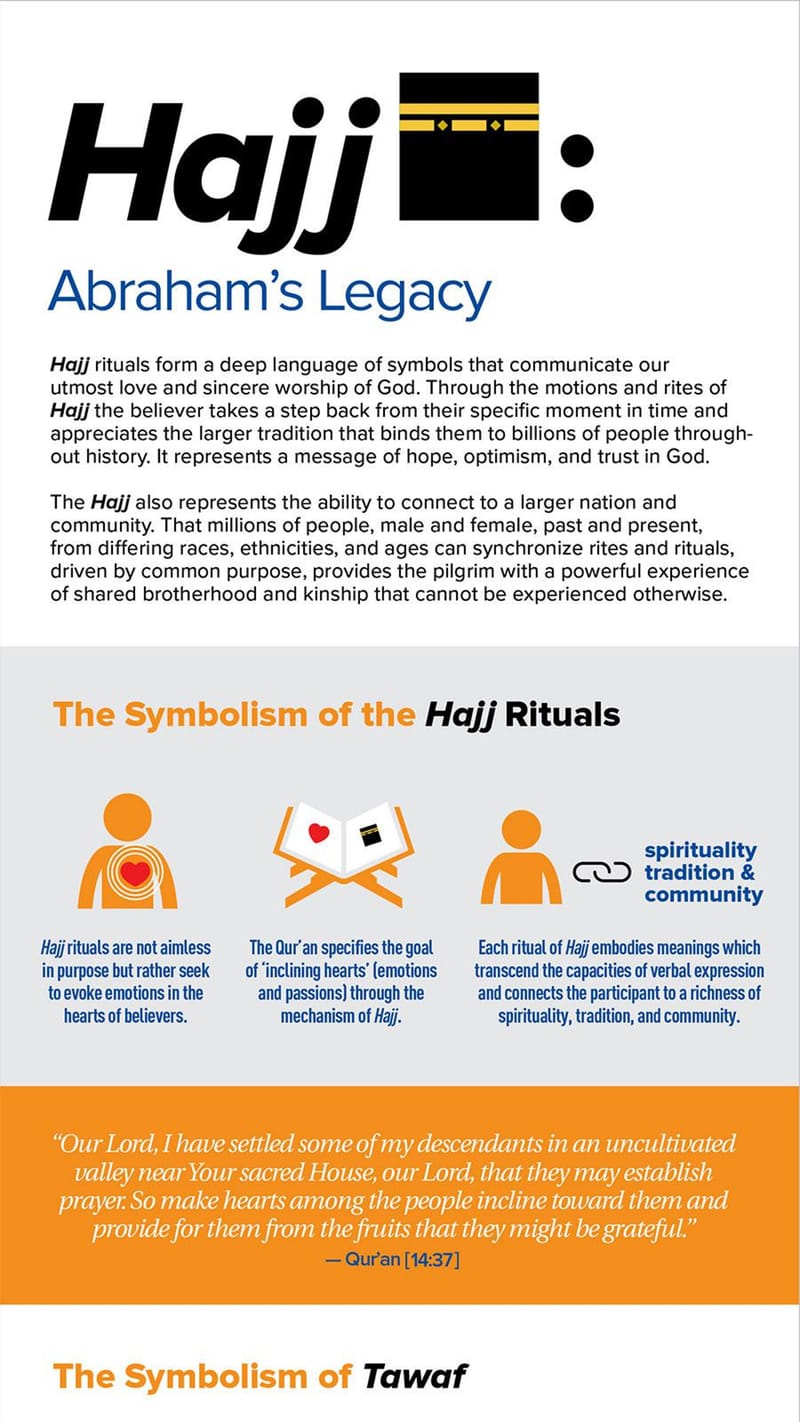
See full infographic on: Hajj: Abraham's Legacy
What is Umrah?
Umrah in Arabic means “to visit a populated place.” It is a shorter version of Hajj, and is also known as the “lesser pilgrimage.” Umrah can be performed anytime during the year. Many people perform Umrah multiple times, each with the intention of connecting with God and seeking forgiveness for past sins.
How is Umrah performed?
Umrah consists of four main rituals: Ihram, Tawaf, Sa’i and Taqsir. These are the steps to follow when performing these rituals during Umrah.
1) Prepare for Ihram (the sacramental state) by bathing and donning the Ihram garments before entering the Miqat (the boundary at which pilgrims must be in the state of Ihram).
2) Enter the state of Ihram by making an intention to perform Umrah and reciting the Talbiyah (a statement declaring the oneness of God and the intention to perform the pilgrimage in order to please God).
3) Enter Masjid Al-Haram (the Sacred Mosque) and perform Tawaf by circling around the Ka’bah seven times in a counter-clockwise direction, starting from the Black Stone and ending at Maqam al-Ibrahim (the Station of Abraham) with two cycles of prayer, followed by drinking one’s fill of water from the well of Zamzam. It’s recommended to drink a large amount to maximize the blessings from that sacred well.
4) Move towards Mount Safa to begin the Sa’i, then walk between the two hills of Mount Safa and Mount Marwa. Repeat this walk seven times.
5) Once Sa’i is complete, pilgrims complete their Umrah by shaving their heads (only men) or shortening their hair (men and women).
Are Umrah and Hajj the same?
While they share some of the same rituals, Hajj and Umrah are not the same. The importance and reward of Hajj is bigger than that of Umrah, but it can only be performed during a specific time of the year, and it involves significantly more steps. Umrah can be performed anytime during the year, and only requires four of the rituals performed during Hajj—Ihram, Tawaf, Sa’i and Taqsir.
POPULAR ARTICLES
Basics of Islam
What is Islam and who are Muslims? This section covers some of the basic questions asked about Islam and pillars that define the faith.
Peace & Violence
For the majority of the world’s 1.8 billion Muslims, Islam represents a comprehensive way of living a peaceful life devoted to God. However, over time, fearmongers and the actions of a few have stirred doubt about Islam’s views on violence. What does Islamic doctrine truly have to say about terrorism, jihad, and honor killings?
Ramadan
Ramadan is the holiest month of the year for Muslims. It’s the period in which the Prophet Muhammad (peace be upon him) was visited by the archangel Gabriel and began to receive the Qur’an—the final scripture revealed by God. Believers commemorate this revelation through prayer, charity, and building a closer relationship with God.
Mental Health & Wellness
Islam has a long scholarly tradition of acknowledging mental health struggles and guiding believers towards healing through both spiritual and clinical means. Explore how trauma, meditation, OCD, and other mental health topics are viewed from an Islamic lens.
Shariah
At its simplest, shariah is the Islamic interpretation of God's law, but it is also a common source of misunderstanding. Read on for an in-depth explanation of sharia, its implementation, and related terms.
Spirituality
In Islam, the sole purpose of creation is to worship and devote oneself God. As God says in the Qur’an: "I did not create jinn and mankind except to worship Me" [Qur’an, 51:56]
Women
How does Islam view women? Do women have rights in Islam? Are men and women equal in Islam? What is hijab? Explore topics around the role of women in society, modesty, inheritance laws, divorce, and other commonly-asked questions about women in Islam.
Islam & Muhammad
The Prophet Muhammad (peace be upon him) and his role in Islam
Palestine
Jerusalem and the surrounding holy lands have historically held an important place in the religious traditions and hearts of Muslim believers around the world. Similarly, Christians and Jews have a rich history in the region. Why is Palestine so important to Muslims? What is Al-Aqsa’s significance in Islam? Is the Palestine-Israel war a religious conflict? Learn the answers to these questions and more in this section.
Gender & LGBTQ
How does Islam understand gender? Learn about Islam’s definition of roles, responsibilities, relationships and interactions. This section also addresses the topic of Islam’s sexual ethics and homesexuality.
Additional Resources
Are you interested in learning more about Islam? Explore the different resources compiled to help you along your journey in learning about the Islamic faith.
Explore more related topics
The Ka’bah (Kaaba) is the original house of worship on Earth, an ancient structure built by God’s command to serve as a symbol of monotheism throughout the ages, God says.,
What Islam Says About...
What is Islam and who are Muslims? This section covers some of the basic questions asked about Islam and pillars that define the faith.
For the majority of the world’s 1.8 billion Muslims, Islam represents a comprehensive way of living a peaceful life devoted to God. However, over time, fearmongers and the actions of a few have stirred doubt about Islam’s views on violence. What does Islamic doctrine truly have to say about terrorism, jihad, and honor killings?
Ramadan is the holiest month of the year for Muslims. It’s the period in which the Prophet Muhammad (peace be upon him) was visited by the archangel Gabriel and began to receive the Qur’an—the final scripture revealed by God. Believers commemorate this revelation through prayer, charity, and building a closer relationship with God.
Islam has a long scholarly tradition of acknowledging mental health struggles and guiding believers towards healing through both spiritual and clinical means. Explore how trauma, meditation, OCD, and other mental health topics are viewed from an Islamic lens.
At its simplest, shariah is the Islamic interpretation of God's law, but it is also a common source of misunderstanding. Read on for an in-depth explanation of sharia, its implementation, and related terms.
In Islam, the sole purpose of creation is to worship and devote oneself God. As God says in the Qur’an: "I did not create jinn and mankind except to worship Me" [Qur’an, 51:56]
How does Islam view women? Do women have rights in Islam? Are men and women equal in Islam? What is hijab? Explore topics around the role of women in society, modesty, inheritance laws, divorce, and other commonly-asked questions about women in Islam.
The Prophet Muhammad (peace be upon him) and his role in Islam
Jerusalem and the surrounding holy lands have historically held an important place in the religious traditions and hearts of Muslim believers around the world. Similarly, Christians and Jews have a rich history in the region. Why is Palestine so important to Muslims? What is Al-Aqsa’s significance in Islam? Is the Palestine-Israel war a religious conflict? Learn the answers to these questions and more in this section.
How does Islam understand gender? Learn about Islam’s definition of roles, responsibilities, relationships and interactions. This section also addresses the topic of Islam’s sexual ethics and homesexuality.
Are you interested in learning more about Islam? Explore the different resources compiled to help you along your journey in learning about the Islamic faith.