WHAT ISLAM SAYS ABOUT...
Basics Of Islam
Islam & Jesus
Jesus, the son of Mary, is considered a prophet and messenger of God in Islam
Who is Jesus in Islam
Jesus, the son of Mary, is considered a prophet and a messenger of God in Islam.
Muslims believe that Jesus (peace be upon him) was not only one of God’s prophets and messengers, but that he was among an elite category among them, distinguished for their extraordinary resolve and determination. This category includes Noah, Abraham, Moses, and Prophet Muhammad ﷺ.
Islam teaches that Jesus was born of a miraculous birth to the Virgin Mary (who is herself highly revered in Islam). He is the Messiah (al-Masih) and the Word and Spirit of God, who performed numerous miracles including healing the blind and lepers, feeding multitudes, and resurrecting the dead.
Muslims also believe in the Second Coming, and hold that Jesus will return to Earth shortly before the Day of Judgment to kill the False Messiah (al-Masih al-Dajjal, the Antichrist). He will rule the world justly, and usher in an era of unprecedented peace and prosperity.
Muslims further believe that Jesus enjoys a special connection and proximity to Prophet Muhammad ﷺ and his nation (i.e. Muslims): He will return to lead and pass away among Prophet Muhammad’s followers. Prophet Muhammad ﷺ also declared that he is “the nearest of people to Jesus,” that they both came with the same religion, and that, “there was no prophet [sent] between us.”
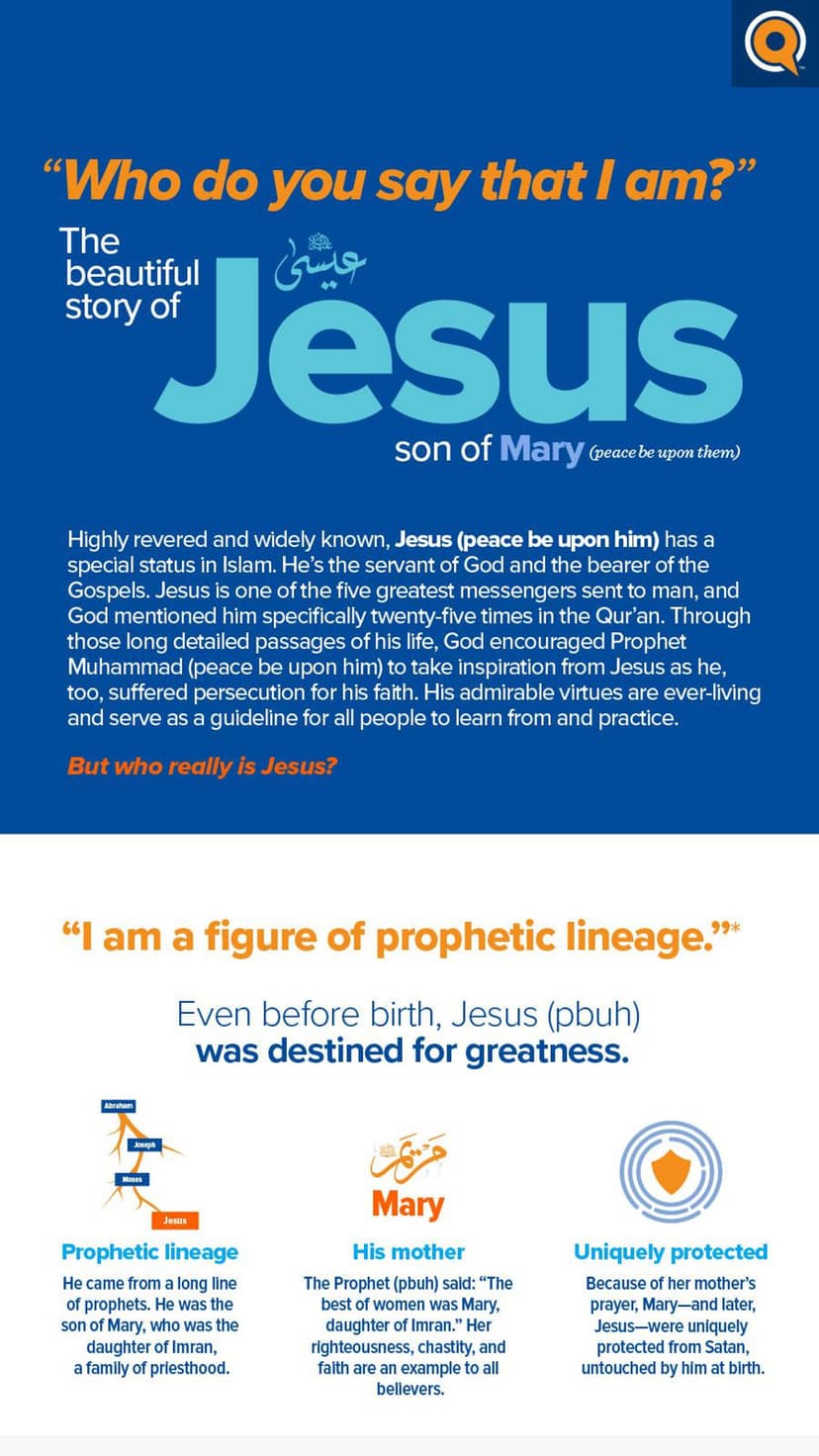
See full infographic on: The Beautiful Story of Jesus Son of Mary (peace be upon them) | Infographic
Do Muslims believe in the crucifixion of Jesus?
No, Muslims do not believe that Jesus was crucified or killed.
While Muslims do believe that Jesus and his followers were persecuted by authorities in his time, and that Jesus suffered betrayal at the hands of some of his own people, Islam teaches that Jesus was miraculously saved from crucifixion and ascended to the heavens where he remains alive.
Do Muslims believe in the Holy Spirit?
Muslims believe in the Holy Spirit (al-Ruh al-Qudus) with reference to the Angel Gabriel (Jibril) and not as a part of a trinitarian godhead.
It was through the Holy Spirit that Jesus was able to perform numerous miracles.
However, Muslims do not believe that the Holy Spirit is a part of a trinitarian godhead, nor a separate god to be worshiped or prayed to. Rather, the Holy Spirit, Gabriel, is a creation of God and under His complete control.
Do Muslims believe in Heaven and Hell?
Yes. Belief in Heaven and Hell are essential aspects of Islamic belief.
Islam teaches that, after death, all of humanity will eventually be resurrected on the Day of Judgement, judged according to their individual actions, and sent to Parardise or the Hellfire.
Paradise is a place of eternal bliss, beauty, pleasure, and happiness, filled with delights that “no eye has ever seen, no ear has ever heard, and what no human mind has ever imagined.” It is a place free of any pain, suffering, sadness, or death.
Hell is a terrifying place filled with pain, suffering, and misery. Some who enter it will eventually be taken out and placed in Heaven, while others will remain eternally.
Video: S1E3 - If God is Merciful, Why Does Hellfire Exist? | DoubleTake
POPULAR ARTICLES
Hajj and Umrah
What is Hajj? When is Hajj? What is Umrah? What is the difference between Hajj and Umrah? Learn about the significance of Hajj, the rituals of Hajj and Umrah, and the answers to other commonly asked questions about Hajj and Umrah.
Peace & Violence
For the majority of the world’s 1.8 billion Muslims, Islam represents a comprehensive way of living a peaceful life devoted to God. However, over time, fearmongers and the actions of a few have stirred doubt about Islam’s views on violence. What does Islamic doctrine truly have to say about terrorism, jihad, and honor killings?
Ramadan
Ramadan is the holiest month of the year for Muslims. It’s the period in which the Prophet Muhammad (peace be upon him) was visited by the archangel Gabriel and began to receive the Qur’an—the final scripture revealed by God. Believers commemorate this revelation through prayer, charity, and building a closer relationship with God.
Mental Health & Wellness
Islam has a long scholarly tradition of acknowledging mental health struggles and guiding believers towards healing through both spiritual and clinical means. Explore how trauma, meditation, OCD, and other mental health topics are viewed from an Islamic lens.
Shariah
At its simplest, shariah is the Islamic interpretation of God's law, but it is also a common source of misunderstanding. Read on for an in-depth explanation of sharia, its implementation, and related terms.
Spirituality
In Islam, the sole purpose of creation is to worship and devote oneself God. As God says in the Qur’an: "I did not create jinn and mankind except to worship Me" [Qur’an, 51:56]
Women
How does Islam view women? Do women have rights in Islam? Are men and women equal in Islam? What is hijab? Explore topics around the role of women in society, modesty, inheritance laws, divorce, and other commonly-asked questions about women in Islam.
Islam & Muhammad
The Prophet Muhammad (peace be upon him) and his role in Islam
Palestine
Jerusalem and the surrounding holy lands have historically held an important place in the religious traditions and hearts of Muslim believers around the world. Similarly, Christians and Jews have a rich history in the region. Why is Palestine so important to Muslims? What is Al-Aqsa’s significance in Islam? Is the Palestine-Israel war a religious conflict? Learn the answers to these questions and more in this section.
Gender & LGBTQ
How does Islam understand gender? Learn about Islam’s definition of roles, responsibilities, relationships and interactions. This section also addresses the topic of Islam’s sexual ethics and homesexuality.

Additional Resources
Are you interested in learning more about Islam? Explore the different resources compiled to help you along your journey in learning about the Islamic faith.
Explore more on this topic
The fundamentals of the Islamic faith, belief, and practice.
The five pillars of Islam are: the testimony of faith, prayer, zakat, fasting of Ramadan, and performing hajj.
Halal refers to that which is permissible to Muslims.
The Islamic stance on divorce
Related Topics
What is Hajj? When is Hajj? What is Umrah? What is the difference between Hajj and Umrah? Learn about the significance of Hajj, the rituals of Hajj and Umrah, and the answers to other commonly asked questions about Hajj and Umrah.
For the majority of the world’s 1.8 billion Muslims, Islam represents a comprehensive way of living a peaceful life devoted to God. However, over time, fearmongers and the actions of a few have stirred doubt about Islam’s views on violence. What does Islamic doctrine truly have to say about terrorism, jihad, and honor killings?
Ramadan is the holiest month of the year for Muslims. It’s the period in which the Prophet Muhammad (peace be upon him) was visited by the archangel Gabriel and began to receive the Qur’an—the final scripture revealed by God. Believers commemorate this revelation through prayer, charity, and building a closer relationship with God.
Islam has a long scholarly tradition of acknowledging mental health struggles and guiding believers towards healing through both spiritual and clinical means. Explore how trauma, meditation, OCD, and other mental health topics are viewed from an Islamic lens.
At its simplest, shariah is the Islamic interpretation of God's law, but it is also a common source of misunderstanding. Read on for an in-depth explanation of sharia, its implementation, and related terms.
In Islam, the sole purpose of creation is to worship and devote oneself God. As God says in the Qur’an: "I did not create jinn and mankind except to worship Me" [Qur’an, 51:56]
How does Islam view women? Do women have rights in Islam? Are men and women equal in Islam? What is hijab? Explore topics around the role of women in society, modesty, inheritance laws, divorce, and other commonly-asked questions about women in Islam.
The Prophet Muhammad (peace be upon him) and his role in Islam
Jerusalem and the surrounding holy lands have historically held an important place in the religious traditions and hearts of Muslim believers around the world. Similarly, Christians and Jews have a rich history in the region. Why is Palestine so important to Muslims? What is Al-Aqsa’s significance in Islam? Is the Palestine-Israel war a religious conflict? Learn the answers to these questions and more in this section.
How does Islam understand gender? Learn about Islam’s definition of roles, responsibilities, relationships and interactions. This section also addresses the topic of Islam’s sexual ethics and homesexuality.
Are you interested in learning more about Islam? Explore the different resources compiled to help you along your journey in learning about the Islamic faith.