WHAT ISLAM SAYS ABOUT...
Basics Of Islam
The Five Pillars
The five pillars of Islam are: the testimony of faith, prayer, zakat, fasting of Ramadan, and performing hajj.
What are the five pillars of Islam?
The five pillars of Islam are: the testimony of faith, prayer, zakat, fasting of Ramadan, and performing hajj.
Islam can be imagined as a building supported by five pillars. Each of these pillars are necessary for the building of Islam to stand. Without them, the structure collapses. These pillars are:
- Shahada: Testifying that there is no god but Allah (God), and that Muhammad ﷺ is the final Messenger of God
- Salat: Praying five daily prayers
- Zakat: Donating an obligatory amount of charity
- Sawm: Fasting in Ramadan
- Hajj: Making the pilgrimage to the Ka’aba
Everything else in Islam is built upon these five foundational pillars.
What is the Islamic testimony of faith (shahada)?
The shahada is to believe in the message of Islam and declare that: There is no god but Allah (God), and Muhammad ﷺ is the Messenger of God.
This testimony of faith, known in Arabic as the shahada, encapsulates the religion of Islam. It must be affirmed in the heart and uttered by the tongue.
The shahada is a declaration of monotheism (tawhid) stating that there is absolutely no deity except for the one, true, creator: God. He has no partners in divinity, no children, and none are worthy of worship except Him.
It is also a statement of acceptance that Prophet Muhammad ﷺ is God’s final prophet and messenger.
Why do Muslims pray daily?
Prayer (salah) forges and sustains an essential connection between a person and their Creator.
Muslims have been instructed by God to pray five times daily within prescribed times. The Qur’an informs us that the primary reason for our creation and existence is to worship God, and these required five daily prayers are, in essence, a foundational fulfillment of this existential purpose.
Video: Pillar 2: Why do we pray?
What is zakat?
Zakat refers to an obligatory portion of wealth a Muslim must give annually to the poor and needy.
Islamic law details the various types of wealth that are zakat-eligible, how it is calculated, and the specific categories of people eligible to receive it.
Zakat is frequently mentioned alongside prayer (salat) throughout the Qur’an and was a ubiquitous feature of all prophetic calls. Among the five pillars of Islam, zakat is unique in that, in addition to being an act of devotion to God, it plays an important social function. While things like prayer and fasting are, on their face, individual acts of ritual devotion, zakat directly benefits one’s community and, as an institution, wields immense economically and socially transformative power.
What is Ramadan?
Ramadan is the 9th month of the Hijri, or Islamic lunar calendar, during which Muslims are obligated to fast each day of the entire month.
Fasting entails abstaining from food, drink, and intimacy from dawn to sunset. All sane, mature Muslims are obligated to fast unless they have a legitimate excuse (due to travel, illness, etc.), in which case Islamic law details if and how they are to make up for missed Ramadan fasts.
The month of Ramadan is also the month in which the revelation of God’s final message to humanity, the Qur’an, began. The Qur’an was first revealed on the Night of Decree (laylat al-qadr), which is described as the greatest night of the entire year.
Why do Muslims have to fast for a full month?
Muslims fast for the entire month because God prescribed this to be the length of the fasting period.
During prayer five times a day, Muslims face the Ka’aba in Mecca. Rituals like this were prescribed by God and, thus, we follow them. Likewise, Muslims fast for the entire month because God prescribed that this be the length of the fast:
Ramadan is the month in which the Quran was revealed as a guide for humanity, with clear proofs of guidance and the standard ˹to distinguish between right and wrong˺. So whoever is present this month, let them fast...
[Qur’an, 2:185]
The aim and purpose of fasting is to develop a greater sense of consciousness of God. Fasting also teaches Muslims self-restraint, and enables people to experience hunger and, hopefully, a greater sense of empathy for those who are less fortunate.
Do Muslims fast outside of Ramadan?
Muslims can voluntarily fast outside of the month of Ramadan, but are not required to do so.
Fasting outside of Ramadan is an extremely virtuous and highly rewarded practice that Muslims are encouraged to do if they can.
In fact, it was Prophet Muhammad’s ﷺ regular practice to fast on Mondays and Thursdays, three days at the middle of each lunar month, and a number of other days throughout the year.
What is the significance of the Hajj pilgrimage?
Hajj is one of the five pillars of Islam.
All Muslims must perform the Hajj once in a lifetime, if they are physically and financially able to do so. Among other things, the pilgrimage is a commemoration of the legacy and sacrifices of Prophet Abraham (Ibrahim), peace be upon him, and his family.
The rituals of Hajj are full of powerful symbolism and lessons, and experiencing them can bring about profound spiritual change.
Video: Pillar 5: What is Hajj (Pilgrimage)?
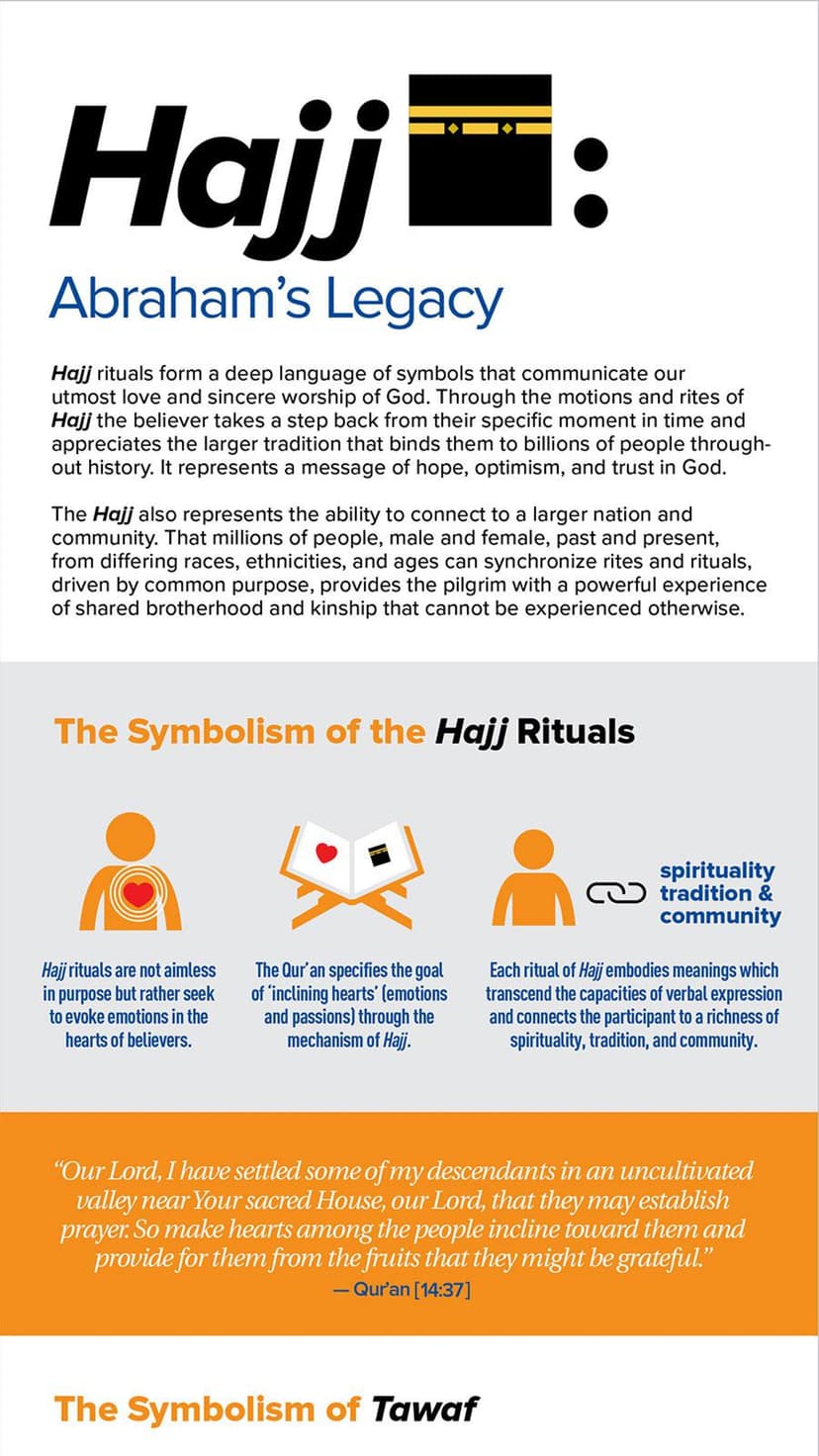
See full infographic on: Hajj: Abraham's Legacy
POPULAR ARTICLES
Hajj and Umrah
What is Hajj? When is Hajj? What is Umrah? What is the difference between Hajj and Umrah? Learn about the significance of Hajj, the rituals of Hajj and Umrah, and the answers to other commonly asked questions about Hajj and Umrah.
Peace & Violence
For the majority of the world’s 1.8 billion Muslims, Islam represents a comprehensive way of living a peaceful life devoted to God. However, over time, fearmongers and the actions of a few have stirred doubt about Islam’s views on violence. What does Islamic doctrine truly have to say about terrorism, jihad, and honor killings?
Ramadan
Ramadan is the holiest month of the year for Muslims. It’s the period in which the Prophet Muhammad (peace be upon him) was visited by the archangel Gabriel and began to receive the Qur’an—the final scripture revealed by God. Believers commemorate this revelation through prayer, charity, and building a closer relationship with God.
Mental Health & Wellness
Islam has a long scholarly tradition of acknowledging mental health struggles and guiding believers towards healing through both spiritual and clinical means. Explore how trauma, meditation, OCD, and other mental health topics are viewed from an Islamic lens.
Shariah
At its simplest, shariah is the Islamic interpretation of God's law, but it is also a common source of misunderstanding. Read on for an in-depth explanation of sharia, its implementation, and related terms.
Spirituality
In Islam, the sole purpose of creation is to worship and devote oneself God. As God says in the Qur’an: "I did not create jinn and mankind except to worship Me" [Qur’an, 51:56]
Women
How does Islam view women? Do women have rights in Islam? Are men and women equal in Islam? What is hijab? Explore topics around the role of women in society, modesty, inheritance laws, divorce, and other commonly-asked questions about women in Islam.
Islam & Muhammad
The Prophet Muhammad (peace be upon him) and his role in Islam
Palestine
Jerusalem and the surrounding holy lands have historically held an important place in the religious traditions and hearts of Muslim believers around the world. Similarly, Christians and Jews have a rich history in the region. Why is Palestine so important to Muslims? What is Al-Aqsa’s significance in Islam? Is the Palestine-Israel war a religious conflict? Learn the answers to these questions and more in this section.
Gender & LGBTQ
How does Islam understand gender? Learn about Islam’s definition of roles, responsibilities, relationships and interactions. This section also addresses the topic of Islam’s sexual ethics and homesexuality.

Additional Resources
Are you interested in learning more about Islam? Explore the different resources compiled to help you along your journey in learning about the Islamic faith.
Explore more on this topic
The fundamentals of the Islamic faith, belief, and practice.
Jesus, the son of Mary, is considered a prophet and messenger of God in Islam
Halal refers to that which is permissible to Muslims.
The Islamic stance on divorce
Related Topics
What is Hajj? When is Hajj? What is Umrah? What is the difference between Hajj and Umrah? Learn about the significance of Hajj, the rituals of Hajj and Umrah, and the answers to other commonly asked questions about Hajj and Umrah.
For the majority of the world’s 1.8 billion Muslims, Islam represents a comprehensive way of living a peaceful life devoted to God. However, over time, fearmongers and the actions of a few have stirred doubt about Islam’s views on violence. What does Islamic doctrine truly have to say about terrorism, jihad, and honor killings?
Ramadan is the holiest month of the year for Muslims. It’s the period in which the Prophet Muhammad (peace be upon him) was visited by the archangel Gabriel and began to receive the Qur’an—the final scripture revealed by God. Believers commemorate this revelation through prayer, charity, and building a closer relationship with God.
Islam has a long scholarly tradition of acknowledging mental health struggles and guiding believers towards healing through both spiritual and clinical means. Explore how trauma, meditation, OCD, and other mental health topics are viewed from an Islamic lens.
At its simplest, shariah is the Islamic interpretation of God's law, but it is also a common source of misunderstanding. Read on for an in-depth explanation of sharia, its implementation, and related terms.
In Islam, the sole purpose of creation is to worship and devote oneself God. As God says in the Qur’an: "I did not create jinn and mankind except to worship Me" [Qur’an, 51:56]
How does Islam view women? Do women have rights in Islam? Are men and women equal in Islam? What is hijab? Explore topics around the role of women in society, modesty, inheritance laws, divorce, and other commonly-asked questions about women in Islam.
The Prophet Muhammad (peace be upon him) and his role in Islam
Jerusalem and the surrounding holy lands have historically held an important place in the religious traditions and hearts of Muslim believers around the world. Similarly, Christians and Jews have a rich history in the region. Why is Palestine so important to Muslims? What is Al-Aqsa’s significance in Islam? Is the Palestine-Israel war a religious conflict? Learn the answers to these questions and more in this section.
How does Islam understand gender? Learn about Islam’s definition of roles, responsibilities, relationships and interactions. This section also addresses the topic of Islam’s sexual ethics and homesexuality.
Are you interested in learning more about Islam? Explore the different resources compiled to help you along your journey in learning about the Islamic faith.